Ellie Rines Gallery is pleased to present From Behind, a solo exhibition of ten new soft sculptures by Al Freeman. Marking Freeman’s sixth solo presentation with the gallery, the exhibition deepens the artist’s investigation into the verso, the hidden back of a painting. The exhibition will be on view from October 30 through November 25, with an opening reception on Friday, October 30 from 6 to 8 pm.
In From Behind, Freeman’s soft sculptures focus on the physical, administrative, and conceptual infrastructure that sustains the art world ecosystem: stretcher bars, foam padding, certificates of authenticity, bills of sale, crates, provenance tags, and even the occasional administrative or art handling error. Inheriting the tactile humor and sagging monumentality of Claes Oldenburg’s Pop soft sculptures, Freeman inflates, caricaturizes, and translates hard, functional studio and storage materials into plush vinyl, felt, and polyfil, treating the mechanics of art production and paperwork of commerce with the finesse we normally find on the recto. The way Freeman finds compositional beauty in what we might consider mundane reflects an impulse to elevate and recognize accidental formal attributes of the verso, imparting upon us her signature conflation of the high and low aspects of culture. Freeman asks might we consider the back of a rarefied object and its accidental composition as important as its front: might every painting be two sided?
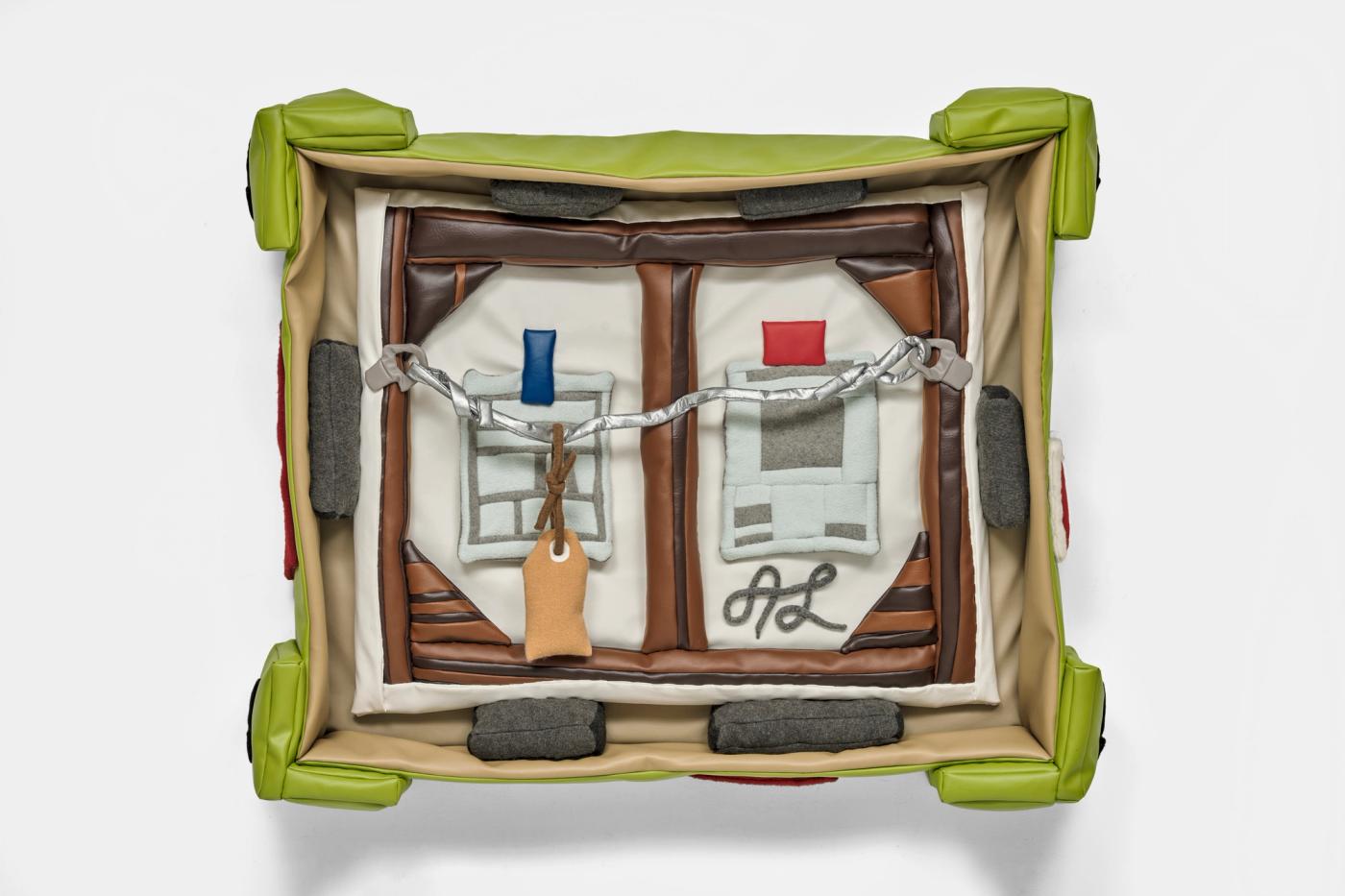
In Landscape in Crate, Freeman draws inspiration from visiting the Whitney Museum’s secret storage space which houses rooms of their unique neon-green crates for artwork. Freeman sculpts the back of a canvas, its horizontal orientation indicating it is a landscape. The “canvas” is secured by plush foam padding and wedged tightly into an open green crate. Taped to the back with vivid blue and red tape are the administrative paper trails of ownership: an abstracted bill of sale and certificate of authenticity. An exposed stretcher bar and silver picture wire partition the surface into four segments, establishing an impromptu grid and a remarkably balanced composition. Stitched directly onto the panel, Freeman’s signature "AL" is rendered in soft graphite colored cursive. The grand gesture of attribution is a squiggly shoelace of a monogram in which imitation and sincerity collapse into one gestural moment.
In Portrait with Stickers, the reality of a well-traveled work is more overtly pronounced: one could almost smell the rich wood grain of the stretcher bars, the nutty fragrance of the linseed oil, and can feel the presence of a work well-loved but oft-traded. The lower half of Portrait with Stickers features a haphazard grid-like scatter of colorful soft stickers, labels, and tape swatches, immediate in their color and signaling; the orchestrated components, the impression of space and chance, a simultaneous feeling of constraint and free association all suggest the visual language of a painting. Freeman translates the motif of the grid into a literal economy of parts, wherein each soft object is sewn, unconsciously placed in composition, and consciously resolved in arrangement. Freeman’s studio process is a rhythmic, meditative flow of sewing and collage, a process akin to drawing in 3D. Without any formal training in sewing Freeman’s stitched lines have a wavy organic quality similar to the loose lines of her drawings. No premade patterns are used and shapes are cut from the cloth freehand. This punk rock approach to fabrication is a trial and error method in which mechanical precision is discarded in favor of intuitive decision-making, spontaneity and ultimately vulnerability.
While Freeman certainly draws on familiar tendencies like irony, citation, and parody, From Behind ultimately reveals a sensibility that is down-to-earth, playful, and deeply sincere. By turning generic “masterpieces” around to highlight their physical presences (and internal spirits), she deflates the rigid authority of the canon, creating an inviting, unpretentious dialogue with the past that swaps stiff seriousness for genuine warmth; Freeman leaves space for her own mind, and the viewer’s mind to imagine their own great recto.