56 HENRY is pleased to present Journey to the West, an exhibition of new work by Michele Cesaratto (b.1998), on view from May 20th through June 28th at 56 Henry Street. Marking Cesaratto’s first solo presentation in North America, the exhibition spans ten painted poplar panels and one handmade rice paper scroll, introducing a world where folklore, friends, maps, and the natural world symbiotically converge.
Cesaratto’s panels are steeped in the traditions and techniques of the Early Renaissance as well as inspired by the terrain of the Italian countryside, where Cesaratto lives and works. Embracing passed down traditions of craftsmanship and empirical observation of nature and material, Cesaratto sources poplar from the woods of Gradisca di Spilimbergo, the small hamlet he is from, grinds pigments, and experiments with egg tempera, techniques he learned from the Academy of Florence and later honed while completing his second painting degree at the Academy of Venice. By way of his processes and art historical referentiality, Cesaratto intentionally straddles the long-standing division of craft and art, of high and low.
A source of inspiration and bedrock for Cesaratto’s visual storytelling is the Tagliamento–a braided, untamed river and considered to be the only river in the Alpine region to maintain its original morphology. The river has served as a historic gathering point, has fostered Friulian legends, folklore, and mythologies, and has historically symbolized travel and pilgrimage in the region. In Locke Island (2026) and L’isola del Giorno Prima (2026), Cesaratto maps the winding and snaking river as it cuts through the mountains. Instead of portraying the topography in an objective manner, Cesaratto imbues his tableaus with a sense of memory, timelessness, ethereality, and intimacy. In L’Isola del Giorno Prima (2026), the moon illuminates a crane landing in the middle course of the river while the earthly pigments transition from shadowy minerals to warm, sun-baked clays; terra rossa forms the soft, pinkish-red hues in the mountain range while pale, minty greens express the small lagoons where the water meets the shore.
Cesaratto’s use of natural color and his vertical compositions highlight the intersection of two of his main inspirations: his relationship with the nature around him for which he nurtures, studies, and cultivates and the harmonious, calligraphic, and romanticist sensibilities of landscape painting from the Song (960-1279) and Yuan (1271-1368) Dynasties. Informed not only by the visual language of Chinese landscape art, but also by Chinese philosophies, Cesaratto creates landscapes that feel self-generating, or an arrangement of natural elements that are continuously changing and interacting, focusing not on the human perspective, but rather on the relationships between various natural elements.
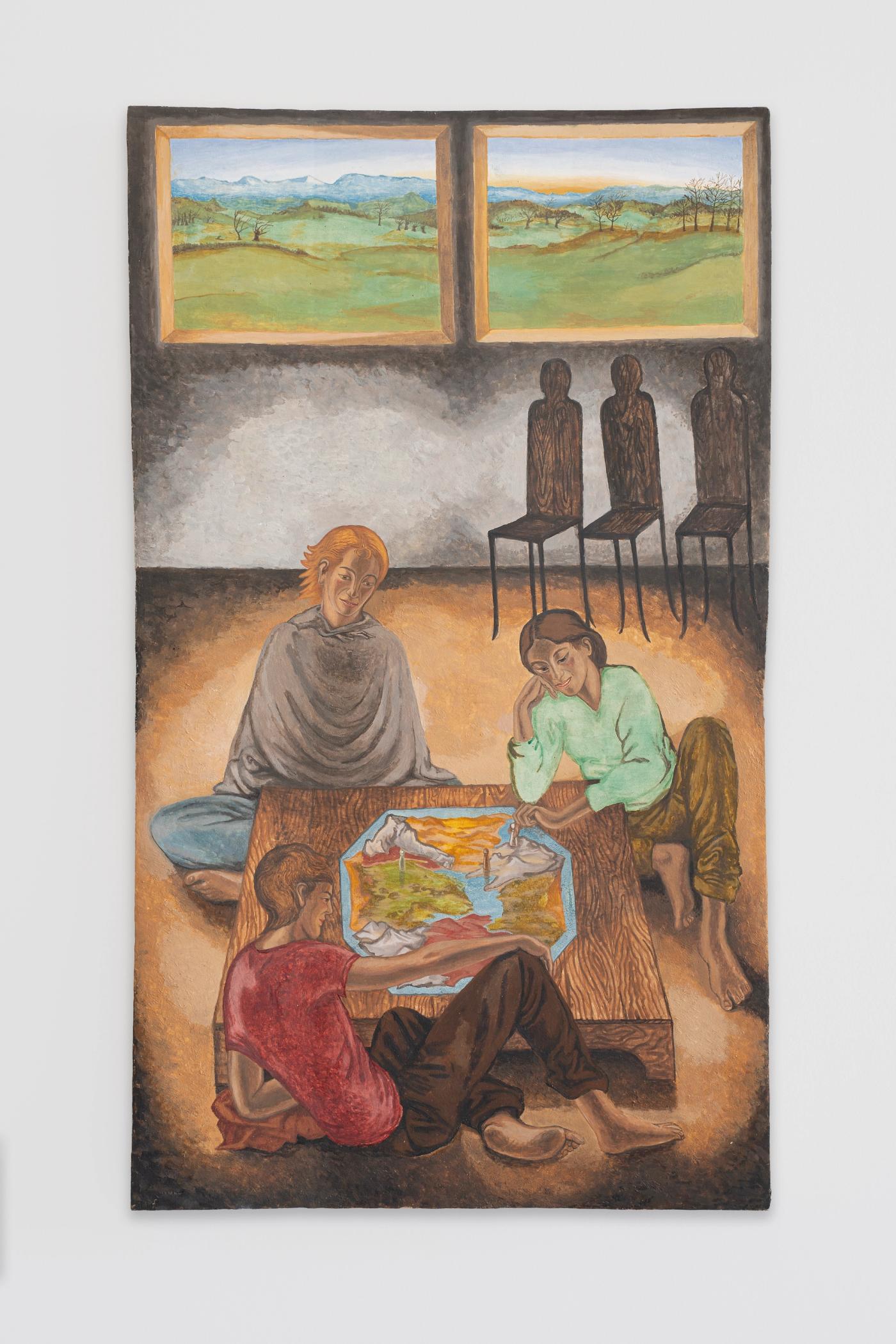
His other works are playful, dreamlike depictions and portraits of friends caught in a reverie, a chuckle, playing a game, or even lounging on a small vessel as they navigate calm waters. In each of the works, the background is always nature; however, Cesaratto collapses the distance between subject and landscape. In Il Ciccio (2026), swirling dust devils rise in the background, mirroring the curls in the subject’s hair and the curves of his hand gesture. A playful tension exists in the work between the distinctly modern and industrial zipper and the background that feels acutely belonging to the Renaissance or a folk legend. There is a sense, or an impression, that the subject is conjuring, stewarding, or guarding this alluring hill. In Due legni per un sasso (2026), Cesaratto expands on blurring the lines between the interior and the exterior; three figures congregate around a game board, a miniature world that resembles the landscape seen through the two rectangular windows. Three tall-backed chairs resemble long, elongated human silhouettes watching over the players. Cesaratto uses a vertically stacked perspective in Verso Ovest (2026) reminiscent of medieval tapestries, creating a flattened and rising sea while a stoic navigator and a reclining figure in crimson evoke a sense of spiritual transition and vulnerability. Through form and composition, Cesaratto pays homage to Early Renaissance masters like Fra Angelico and Pisanello, wherein portraiture and genre paintings, more than mere likeness, attempted to evoke the identity or personality of the sitters.
The exhibition title references the 16th-century Chinese novel of the same name. The novel follows a monk’s fantastical 19-year pilgrimage in search of Buddhist scriptures. The early stages of the epic deals with the exploits of Sun Wukong, a magical monkey birthed from an ancient stone which formed by the coupling of Heaven and Earth. Wukong is trained in the art of polymorphic transformation, combat, and the secrets of immortality, an allegorical character representing the vastness of the creative mind. For Cesaratto, the monkey guides some of his subjects and invokes unbridled playfulness; the monkey personifies Cesaratto’s seamless blend and intertwining of disparate cultures, a longstanding tradition of hybridity and translation in Northern Italian art. Additionally, the narrative relates to Cesaratto’s own journey to the west, while also offering a literary backdrop to his visual language and fictional world building. To expand on this idea, Cesaratto includes a handmade scroll made with ink on rice paper of five deities following a trail. The scroll traditionally typifies travel and long-form narrative in ancient cultures, and in this case, adds to the “Odyssean” nature of Cesaratto’s work. The scroll, like the entirety of Cesaratto’s practice, emphasizes a metaphysical sense of motion, a harmonious oscillation between time, space, and the imaginative elsewhere.